

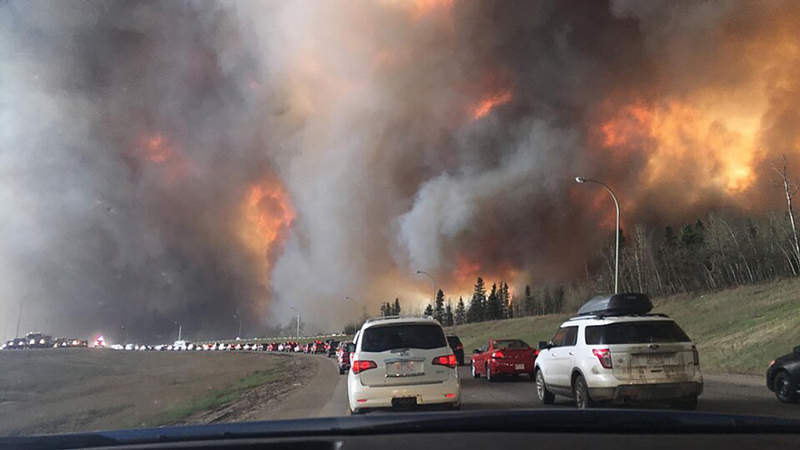
Flames and smoke threaten bumper-to-bumper traffic along congested Highway 63 south during the evacuation of Fort McMurray.
A history-making wildfire 10 years ago in Fort McMurray demonstrated that Albertans can and do work together in times of extreme danger and need, an NDP member reminded the legislature last week.
Kyle Kasawski, who represents the Edmonton-area constituency of Sherwood Park, acknowledged the anniversary of a fire dubbed The Beast by noting the courage, service, charity, resilience and volunteerism that ultimately proved to be the emergency’s match.
On May 3, 2016, about 90,000 people were forced to flee Fort McMurray and neighbouring communities. The exodus remains the largest and most rapid single-day evacuation in Canadian history — and, some sources suggest, the history of modern forest fires anywhere.
“Cellphones and dash cams captured video that day of Albertans cursing, praying and weeping as they escaped the flames reaching over their cars, the sky raining fire, and blasts of heat so intense they could not touch their car windows,” Kasawski said.
“Choices that day were stark and few. There was now and there was never for most people in Fort McMurray,” he said.
“The rest of us could only follow the news hour by hour, horrified by what we were hearing and seeing, left wondering how: how did this fire turn on the city so quickly? how would everyone get out? how could we help?”
Albertans immediately opened their homes to evacuees. Universities opened their dorms and hotels provided rooms. People donated what they could, supporting families who had lost almost everything but “were glad just to be together, safe and alive.”
No fatalities were directly caused by flames or smoke, although two teenagers were killed in a highway collision during the evacuation.
In the end, the toll of The Beast hit $3.7 billion in insured losses, making it the industry’s costliest Canadian natural disaster.
The Fort McMurray fire is bookended by two others with similar storylines.
Most recently, in July 2024, a convergence of fires in Jasper National Park wiped out about a third of the town and damaged almost 33,000 hectares of land. Some 25,000 permanent and temporary residents and visitors were forced to flee the park.
One firefighter in the Jasper Complex Wildfire died when he was struck by a falling tree.
A firefighter death was also recorded back in 2011 in another precedent-setting wildfire. A pilot was killed when the helicopter he was flying crashed into water in the Slave Lake area.
That fire also destroyed roughly a third of the town itself, located about 255 kilometres north of Edmonton. About 15,000 people evacuated the region.
The Kenow Fire of 2017 damaged more than 20,000 hectares of Waterton Lakes National Park in the southwest corner of Alberta. Its townsite was spared, although flames came within 50 metres of the historic Prince of Wales Hotel and the visitor centre burned to the ground.
The Lost Creek Fire of 2003 forced the evacuation of about 2,000 residents of Crowsnest communities in southern Alberta, but no homes or businesses were destroyed.
The province typically spends billions a year fighting and responding to wildfires. Expenditures hit $2.9 billion in 2023-’24 when 2.2 million hectares burned.
Almost four times the size of Prince Edward Island, the damaged area represented a major jump from the previous record of 1.3 million hectares.
A decade ago, Albertans “witnessed extraordinary acts of courage,” Kasawski said.
Some firefighters kept working during the days of The Beast, even though they knew their own homes were likely being consumed by the fire. RCMP and Alberta sheriffs guided tens of thousands to safety. Health care workers refused to leave until every patient was evacuated.
Teachers and childcare workers ensured that their charges made it safely to parents, and “just as importantly” neighbours also demonstrated the “community heroism that saves lives” by helping each other.
“As we reflect 10 years later, we recognize Fort McMurray’s resilience,” said Kasawski, the shadow minister for affordability and utilities.
“We acknowledge that changing climate conditions are making disasters like this more frequent and severe, a reminder of the importance of being prepared, taking responsibility and taking care of each other.”
“Today we honour those affected, those who helped, the strength of a community, and a province that came together when it mattered most.”