

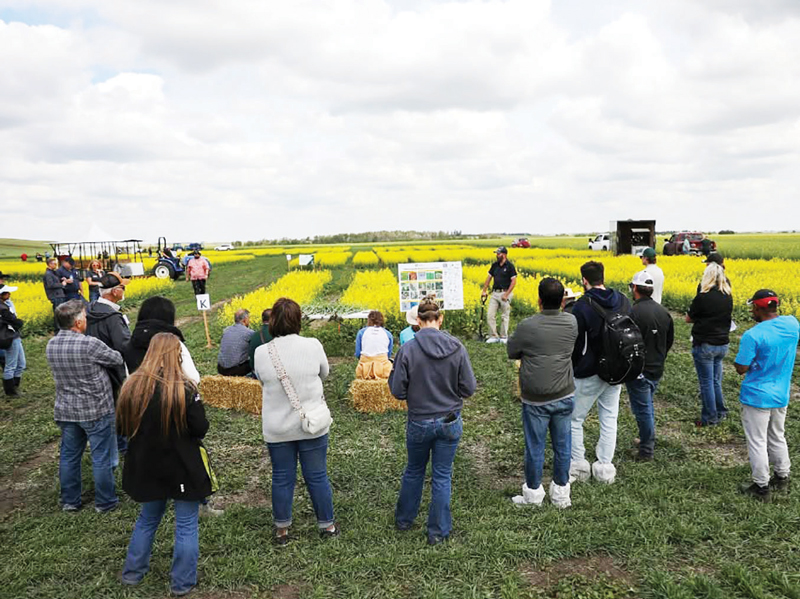
Lakeland College holds a crop diagnostic day near Vermilion in east central Alberta. The event has industry experts from across the province sharing insights in crop management.
Specialized advanced education in and around rural centres helps keep agriculture in Alberta thriving, says a member of the provincial cabinet.
Myles McDougall, who in May 2025 became minister of advanced education, called agriculture a high-tech sector that relies heavily on post-secondary support.
“People like to talk about how important the oil and gas sector is to the province, and it is important. But the number two industry for Alberta is agriculture,” said McDougall, the UCP member representing Calgary-Fish Creek.
“We have a long history of agriculture in the province, and the industry is growing, so we continue to make investments to ensure that we have the workforce it’s going to require,” he said.
McDougall added that “we want to try to provide support for people who want to stay as close to their communities as possible,” noting that it can’t happen all the time.
McDougall’s comments follow the announcement of over $7 million in provincial spending to improve Lakeland College’s Vermilion campus, about 190 kilometres east of Edmonton.
Provincial dollars are combining with more than $1.8 million from the college itself and external funders. The money is being used to upgrade and expand the Vermilion beef yard and upgrade and relocate the campus’s horse pens and related facilities.
The minister’s comments also land as a controversial restructuring continues at a college campus 550 km northwest of Edmonton in Fairview, with the aim of rescuing a renowned veterinary technology program.
The satellite campus lost its connection to Northwestern Polytechnic in Grande Prairie, which announced last year it was shutting down Fairview.
Northern Lakes College in Slave Lake has since stepped in to advance some version of the campus, although much of the curriculum shifts to Grande Prairie.
The province has acquired livestock from the Fairview campus. “We want to make sure that the vet tech program, for example, will continue to operate in that region,” the minister said.
The improvements in Vermilion will expand training capacity, modernize learning spaces, improve animal welfare and “strengthen the connection between students, employers and the rural communities they support,” said a government news release.
Originally built for 60 students and 100 cows, the beef yard today supports more than 80 students and 220 cows. Upgrades align the yard with demand and will also support growth, according to the government.
Old horse pens will be replaced with modern, purpose-built spaces that improve safety, animal care and hands-on training.
Project construction was scheduled to start this month, aiming for completion in November 2028.
Along with Olds College of Agriculture and Technology, Lakeland is one of just two remaining colleges with agriculture-related education as their main purpose. Lakeland has a second campus in nearby Lloydminster.
Olds is midway through a major capital reinvestment with $63 million of provincial support over three years.
The renovation of the W.J. Elliott Building there will see 440 new seats added for trades programming at Olds and, tapping into the province’s collegiate school system, 100 seats for dual-credit trades programs for high school students.
In southern Alberta near Medicine Hat, a collegiate school called the Yuill School of Agriculture is slated to open in the fall of 2027.
Three-year capital spending for advanced education grew to $1.83 billion in the current budget, up almost 20 per cent or $300 million from $1.53 billion the year before.
McDougall said that post-secondary curriculum supporting agriculture lives on campuses across the province, despite the necessity to rethink Fairview.
“We have programs in Lethbridge, we have programs in Medicine Hat, we have programs at Olds that are perfectly located in rural settings in different regions of the province,” he told The Macleod Gazette.
As a proportion of the population, the percentage of people working in agriculture in Alberta is dropping, McDougall acknowledged. Consolidation, mechanization and technological advances make farming more efficient and less labour intensive.
But at the same time, the sector is growing while expanding into new crops and processes, so post-secondary education needs to keep up.
Farming is “very focused to maximize productivity,” meaning the sophistication and knowledge for emerging technologies and equipment require additional education.
According to Statistics Canada, farm receipts in Alberta grew by nearly 80 per cent between 2015 and 2025 to more than $24 billion.
Primary agriculture and food and beverage manufacturing contributed about $10.9 billion to Alberta’s GDP in 2025, compared with over $10 billion the year before and $7.5 billion back in 2015.
Alberta’s No. 1 sector is more than eight times that size. Oil, gas and mining were worth $91.6 billion in GDP last year.
Despite increased efficiencies in agriculture, a labour shortage could be coming.
The Canadian Agricultural Human Resource Council projects 19,600 unfilled agricultural positions in Alberta by 2029, thanks to industry growth, retirements and a skills gap.
In 2023 during peak season, agriculture employed nearly 62,000 people in Alberta, up from over 59,000 the year before.
When food and beverage manufacturing are added, the Alberta government estimates that the employment number reaches over 83,000 people.
Across the country, Statistics Canada tracked in 2023-’24 that nearly 20,000 post-secondary students were enrolled in purely agricultural or veterinary programs.