

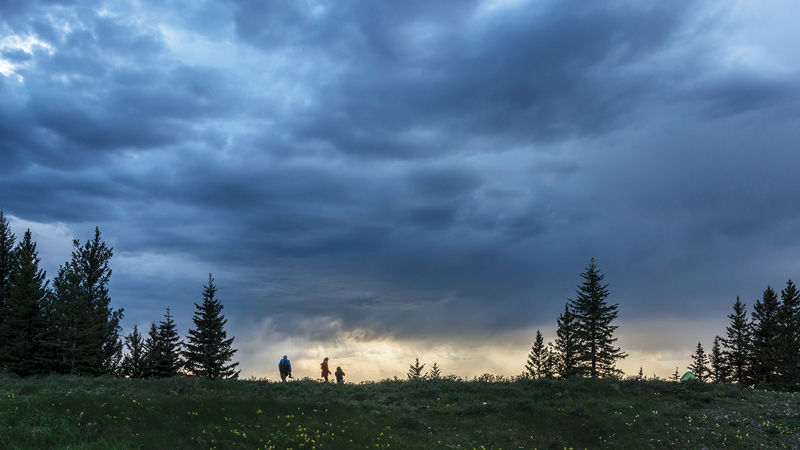
Tourists explore a ridge in Cypress Hills Provincial Park under threatening skies. Humans cause far more wildfires in Alberta than lightning does, but according to the province 70 per cent or more of the area burned is the result of strikes. Photo by iStock
A cherished corner of southeastern Alberta vulnerable to extreme wildfire is getting the risk mitigation it needs, a cabinet minister assured the legislature last week.
Todd Loewen, minister of parks and forestry in the UCP government, highlighted vegetation management, fuel reduction and fireguard construction in the Cypress Hills region, an ecologically and geologically unique area of the province.
Calling the work examples of Alberta’s integrated approach to wildfire mitigation, Loewen said prevention efforts in Cypress Hills Provincial Park and near the park’s Elkwater townsite address special risks in the area.
The province has pruned, thinned, mulched and burned park vegetation, which represents a “commitment to protecting our communities and forest areas,” he said.
The province recently cut a 1.8-kilometre long, 50-metre wide fuel break near the townsite and plans other fireguards and fuel reduction efforts. Focused on removing high-risk standing timber from public lands, Alberta’s hazardous fuel reduction program aims to prevent fast-moving wildfires within five kilometres of vulnerable communities.
Justin Wright, the UCP member representing Cypress-Medicine Hat, said residents of the area “deserve to be reassured that help is ready and the community is protected.”
Emergency evacuations would displace large numbers of people and put “tremendous pressure on emergency responders,” he said.
Wright noted that a recent study warns of major wildfire risk due to the unique terrain, vegetation and weather conditions of the area. Residents, tourism operators and small-business owners there “rely on a safe and accessible environment to make their living.”
Cypress Hills is known as an island of lush forest that rises out of the grasslands and semi-arid prairie. High enough to escape the last glaciations in Alberta, it is home to plants and animals that exist nowhere else on the Prairies.
Loewen, the member for Central Peace-Notley, characterized wildfire prevention and mitigation as a “collective effort” involving communities, industry, Indigenous partners and governments. The groups strive to reduce wildfire risk and “build resilience in communities like Elkwater and others across the province.”
Cypress Hills Provincial Park is the Alberta side of an interprovincial park shared with Saskatchewan. It typically attracts up to 300,000 visitors a year.
Elkwater townsite is home to about 80 permanent Alberta residents, with a population that more than doubles in the summer.
The destruction of parks and their communities hit the international news cycle in July 2024 with the Jasper Wildfire Complex in Jasper National Park, a convergence of fires that devastated the town and damaged almost 33,000 hectares of land.
The Kenow Fire of 2017 damaged more than 20,000 hectares of Waterton Lakes National Park. Its townsite is about 350 km west of Elkwater.
The Lost Creek Fire of 2003 forced the evacuation of about 2,000 residents of Crowsnest communities in southern Alberta.
The province typically spends billions of dollars a year fighting and responding to wildfires. Expenditures hit $2.9 billion in 2023-’24 when 2.2 million hectares burned.
Almost four times the size of Prince Edward Island, the damaged area represented a major jump from the previous record of 1.3 million hectares.