

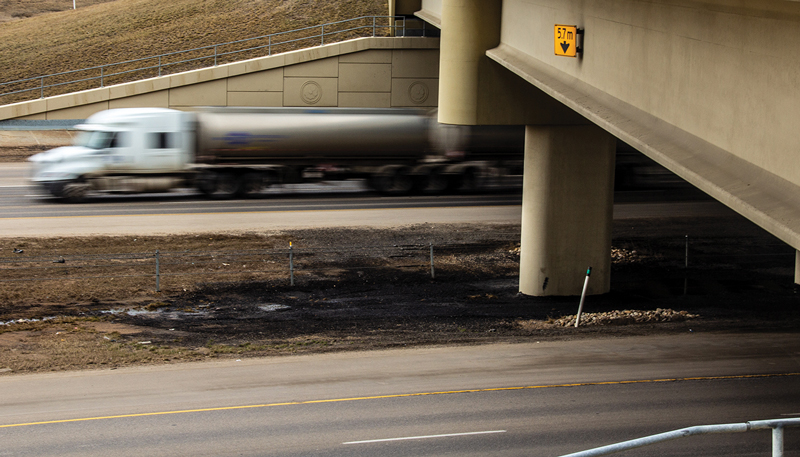
Overpasses and bridges on major roads like this one or more minor ones — are fixed targets for ill-informed, ill-prepared, ill-trained or just plain absent-minded truckers. Photo by Features West Studios
Critical days lie ahead for a rules-and-roads navigation and permitting tool for truckers, Alberta’s Official Opposition warned.
Speaking to reporters, the NDP’s Lorne Dach emphasized that success for the Canadian Trucking Regulations Hub — a digital tool set to launch today — depends entirely on real-time accuracy and ongoing oversight.
“I’m in support of it,” the shadow minister for transportation and economic corridors said. “We’re just going to watch the implementation and make sure long-term oversight is not dropped.”
With an eye for adoption across Canada, the hub features point-to-point mapping so drivers can move their trucks and payloads along safe, efficient and legal routes, said the responsible cabinet minister.
Anticipated results include fewer bridge strikes from over-height loads, millions of dollars in savings to governments and insurers, and better traffic flow and road safety for everyone, added Devin Dreeshen.
Increases in reported bridge strikes are a “bad phenomenon that seems to be happening in Alberta and across the country,” said Dreeshen, the minister of transportation and economic corridors.
From 2023 to 2025, Alberta absorbed 39 bridge strikes on provincial highways alone. Of those, 23 were over-height strikes that cost taxpayers $11 million in repairs, the province claims.
Although the province’s reporting rigour has since increased, 10 or fewer bridge strikes a year appears to be the norm before then.
Part of the hub’s recipe for success is better regulatory adherence, which becomes especially important as the system rolls across multiple provinces and territories.
“This is a really good proactive measure here in Alberta, and we anticipate the rest of the country will be able to follow Alberta’s lead,” said Dreeshen, the UCP member representing Innisfail-Sylvan Lake.
Alberta spent about $75,000 creating the hub and hopes to turn it over in the fall to the Canadian Council of Motor Transport Administrators.
Comprising Canada’s 14 provincial, territorial and federal governments as members, the Canadian Council of Motor Transport Administrators is an umbrella organization for motor vehicle transportation and highway safety.
That handoff will be especially critical, said the NDP’s Dach, who represents the Edmonton-McClung riding. So will the hub’s reliance on other provinces and territories to keep their content current.
If the transition is fumbled and ongoing management suffers, “mistakes will be costly,” Dach said.
When truckers punch in their plans, the road ahead will be “clear sailing, as far as they’re concerned,” he said. “Highways change. Overpass heights and widths and bridges change. That information has to be updated constantly, because drivers are going to rely on it.”
Dreeshen pointed to permit issuing and regulation navigation as other key components of what the province calls a “speed of business” hub.
Landing on identical, cross-Canada rules and regulations — called harmonization — is a longshot, Dreeshen admitted.
Equivalency, which is closer to what jurisdictions shoot for, is “obviously more complicated” for truckers. “But with this hub, we’re hoping that can easily be rectified through technology.”
The goal is to “not just have permits approved instantly, but also have better recognition of different provincial rules.”
Over recent years, trucking safety and regulatory and training equivalence have been high on the UCP agenda. That’s a natural result of transportation routes and economic corridors being “embedded in our DNA” at the province’s birth in 1905, said Dreeshen.
“Whether that’s by road, rail or pipeline, we have to cross other jurisdictions to get our products to market,” he said.
Alberta upped investigations and enforcement recently by getting what it calls bad actors off the road. Last year the province closed five truck driver training schools and removed 13 commercial operators from service.
It’s also developed Learning Pathway to build upon national training standards for truckers and lead the way to Red Seal-style certification in multiple provinces.
More improvements are on the horizon for provincial roads, like better warnings that include sensors and lighted beacons before truckers reach bridges. Physical impact absorbers are envisioned, too, because they’re far cheaper to repair or replace than bridges.
“We want to make sure we can reduce or essentially eliminate these types of accidents,” Dreeshen said.
Bigger bridge-strike fines are possible too. “Hopefully the hub will prevent everything,” when it comes to bridge strikes, Dreeshen told reporters last week.
“If (truckers) are striking bridges, even with better pre-planning, then there needs to be a more appropriate fine. We’re still looking at the final number, but an announcement will be coming soon.”
Dach, meanwhile, said he welcomes the UCP’s leadership on national transportation issues.
Truckers and their associations “have been calling for this for quite some time, and I know the province has put some work into it,” he said.
“It’s just an example of what Alberta can do as a province to lead inter-provincially,” he added, before pivoting to one of his favourite criticisms of the UCP.
“If they would show the same type of leadership to, say, find out how rural bus transportation could be re-established right across Canada, that would be another good thing to do.”