

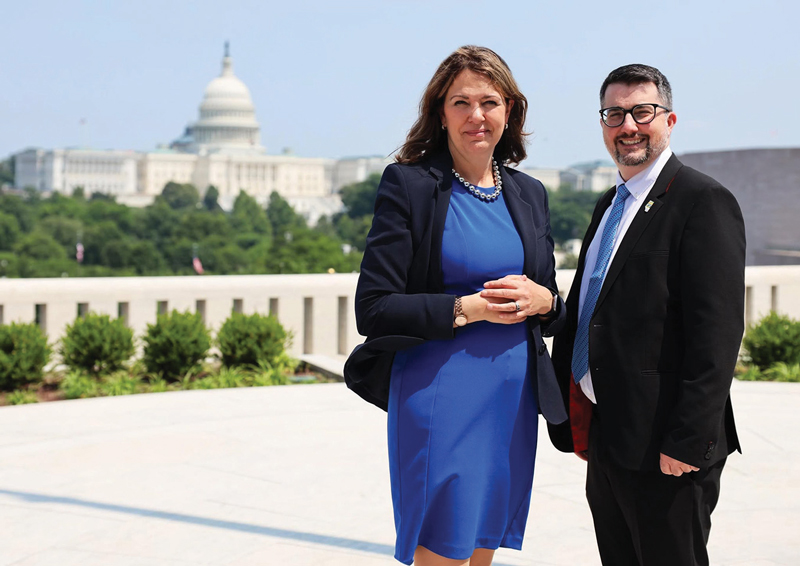
In Washington, D.C., in front of an iconic background, Nathan Cooper poses with Alberta Premier Danielle Smith. Photo from Facebook/Nathan Cooper
Charisma, political nerdiness propelled Nathan Cooper to the Beltway
Brimming with ambition and tell-me-your-story curiosity, by 2010 Nathan Cooper had returned to small-town Alberta with his young family.
He was a future Speaker of the House in a province where he’d spent most of his childhood, living in or around places like Nordegg, Leslieville, Westlock and Sundre.
And soon enough — in a mere 15 years — Cooper would become Alberta’s senior trade representative in Washington.
But for now Cooper was a fresh face in Carstairs in south-central Alberta, and he and he a 30ish-year-old man who displayed an engaging, friendly and intelligent eagerness among his 5,000 or so new neighbours.
“He’s a very charismatic speaker, right? A good speaker. People gravitate towards him,” explained Dean Allan, a local chiropractor who served alongside Cooper as a town councillor.
Much of Cooper’s appeal stemmed from an authentic interest in the lives and times of the citizenry, Allan said.
“He’d go to the seniors lodge, you know, and sit there for hours and talk to people,” said Allan, who today is mayor of the town that lies about 70 kilometres north of Calgary, just west of Queen Elizabeth II Highway.
“He’d ask personal questions, like where were you born? where did you grow up? And he’d be genuinely wondering what the answers were. They weren’t fake questions to get people to talk.”
How Carstairs still connects
These days Cooper puts those people skills to use keeping Alberta on the radar of his home country’s largest trading partner and its 50 states. Among the world’s strongest and most resilient economies, the U.S. has historically consumed most of the resources and farm products Canadians get to market.
Many of those Canadians ply their trades in places like Carstairs, where it’s doubtful many locals pictured Washington in Cooper’s future.
But regardless of where Cooper might end up, it was obvious to Allan and others that the council table wouldn’t be the future MLA’s last political stop.
“He had that drive and he wasn’t shy about saying that he wanted to be in politics. He enjoyed it,” Allan recalled.
Those rural roots matter to Cooper himself, despite how far his job has taken him from the fields and storefronts of central Alberta. (For those counting, D.C. is about 3,725 kilometres away by car.)
Life and work among U.S. lawmakers, Cooper maintains, is “easy to connect” to the farmers, oil-and-gas workers, retirees and other voters of Olds-Didsbury-Three Hills who elevated him to the provincial stage in 2015.
“The relationship between Alberta and the United States is, by orders of magnitude, the most important international relationship that the province has,” Cooper said in a phone interview earlier this year from stateside.
“So it was a great honour to be asked by the premier to serve during such a time as this.”
That time would be Donald Trump’s tumultuous and tariff-hungry second term as president.
The appointed position was born of an earlier trade crisis, however — the one surrounding BSE, a.k.a. mad cow disease. The Americans had banned the import of all Canada’s live ruminants and ruminant meat products after the discovery of BSE in a single Alberta cow on May 20, 2003.
Then-premier Ralph Klein of the Progressive Conservative Party of Alberta decided someone in Washington needed to advocate directly with U.S. lawmakers and power brokers about the safe supply of Alberta beef. Wrapped into the role was further trade advocacy important to the two integrated economies.
And so it was that the position Cooper holds today — now called Alberta’s senior representative to the United States of America — was created.
“Our mission remains essentially the same,” said Cooper, who’s over a year into the role. “It’s about energy and it’s about agriculture. I truly see my job as, by extension, representing Albertans in this important economic and cultural relationship.”
Of people and snowplows
But he’s not dismissive about what it means to be to a town councillor.
“The great thing about municipal politics is that you’re close to the actual concerns and problems of the people,” Cooper said.
“Decisions you make have a direct impact on members of the community, whether that’s their recreational or cultural infrastructure or what day their garbage gets picked up or when their roads get plowed.”
“That’s one of the reasons I loved municipal politics so much.”
But he moved on.
The former WestJet lead flight attendant successfully ran in 2015 under the banner of the Wildrose Party to become MLA for Olds-Didsbury-Three Hills.
It was widely known Cooper would seek higher office, so the move was no huge surprise, Allan said. “We didn’t know it would happen that quick though,” the mayor quipped.
Cooper had already worked for the party in paid positions, having spent six months as its chief of staff and almost a year as the Opposition director of legislative affairs.
As a volunteer, Cooper managed a successful campaign for a Wildrose candidate who ran in the 2012 general election to represent Chestermere-Rocky View, a Calgary-area constituency of the day. With 58 per cent of the vote, Bruce McAllister won a seat in the legislature.
In 2017 Cooper became interim leader of the then-fledgling United Conservative Party. Soon after, members would choose Jason Kenney as permanent leader and Albertans would elect the UCP to replace the NDP.
Much of Cooper’s provincial-level political experience was of the unelected variety, and the public and media took notice of his interim role. Thanks to some social conservative credentials, the light was not all positive.
Cooper had to defend himself before the microphones because of a past role hosting a Calgary internet show called Family Action Radio. At least one guest and the group he worked for, Canada Family Action, had expressed anti-LGBTQ views.
The interim leader said that his views had evolved. “I think there are lots of things I didn’t understand then that I know now,” published reports of the day quoted him saying.
The nerdy speaker emerges
The short-lived controversy didn’t bury Cooper. In fact the legislature elected him as Speaker in May 2019, with Kenney by now the premier.
This came despite no cabinet experience for a boyish-looking MLA still shy of 40 years old.
Dave Hanson of the UCP, for one, had noticed that Cooper had a deep knowledge of legislative protocol.
While serving as house leader for the UCP in opposition, Toronto-born Cooper had impressed Hanson and others as a student of politics, democracy and parliamentary tradition.
Hanson was the member for Bonnyville-Cold Lake-St. Paul, and the deputy house leader while the party was in opposition.
“I very quickly learned that he is indeed an absolute parliamentary and political nerd and that there is no one more suitable for the title of Mr. Speaker,” Hanson said in nominating his party colleague.
Cooper demonstrated “the decorum required to maintain respectful, productive debate” while honouring democratic institutions, Hanson said.
Alberta’s future man in Washington remembers taking the Opposition house leader role seriously, noting it put “significant demands” on his time to address and learn process and tactics.
“Legislatures are interesting places. They have their own language. They have their own sets of rules,” Cooper explained.
“Even though our parliament reflects something similar to the federal Parliament or the House of Commons in the U.K., there are certainly lots of Alberta-specific nuances.
“There was an absolute ton of work and things that I still needed to learn. So it was good to have a baseline knowledge of the procedures and practices that took place in the house.
“It was something that — well, no one actually campaigns to be Speaker. But it was something I had expressed some interest in to my colleagues, and I’d let the premier of the day know that I felt that my skills would be best used helping the entire assembly navigate the legislative agenda and assisting members with process-type challenges.”
It was also a mission of sorts, albeit one with modest expectations. “I used to joke that there are tens and tens of people who cared about the legislative process, and my goal was to turn it into dozens and dozens of people.”
When Cooper was ceremonially dragged down the aisle to the Speaker’s chair, the UCP lost a major question period weapon, laments Devin Dreeshen, today’s minister of transportation and economic corridors.
“He was missed on our benches, because he’d been a very good heckler as an Opposition member,” he said with a chuckle.
“But he’s a really respected and great individual, and I think he’s been doing a really good job as our representative down in Washington, D.C.,” said Dreeshen, whose own constituency of Innisfail-Sylvan Lake borders the one Cooper once represented.
Where it all started
That move to Washington happened a mere decade after Cooper’s first election to provincial politics.
But its antecedents are in elementary school, where Cooper first got “heavily involved” with student politics, a blog from his second Carstairs council campaign says.
“I grew up in a family where public service in some capacity was important, whether it was my parents volunteering or helping with their community of faith, or whatever the case may be,” Cooper explained in his Macleod Gazette interview.
“So I was always kind of connected to the political sphere or found it interesting.”
At 17, Cooper represented Canada as a Rotary Youth Exchange student on the Sunshine Coast of Australia. He would later return to Australia with his wife as regional vice-president of an ecotourism company.
But how would such worldly savvy and political ambition play in a conservative-leaning Carstairs, smack in the heart of some of Canada’s best farm land? Very well, as it turned out.
People noticed Cooper and he noticed them right back. And he made a point of analyzing the composition of their elected council.
Carstairs had plenty of young families, like his was at the time. But council was largely made up of more established, older residents.
So Cooper started talking about that lack of representation, “and I was successful in winning a seat.”
Young voices are always good for politics, Cooper stresses, and so are voices from other demographics.
“I believe that our democracy works best when those elected are a reflection of the population,” the 46-year-old said.
A “diverse group of legislators” offers the best chance at a strong democracy, “whether that’s some lawyers, some teachers, some farmers, some entrepreneurs, some social workers, or some other diverse cross-section of Albertans.
“That’s really what happened when I got elected to town council. I wanted to be able to bring that voice of the young family to the decision-making table.”
Robust representation from a neutralized role
Being anyone’s voice got more complicated after the 2015 election.
As an Opposition MLA, Cooper had the interests of 45,000 or more residents now on his plate. And his party wasn’t in power.
Then when Cooper ended up on the governing side of the legislature for the UCP, the speakership prevented him from using the floor to tout his communities or represent their concerns and viewpoints.
“This is one of the challenges that all Speakers face,” Cooper acknowledged. “How do we robustly represent the needs of our constituents, while at the same time filling a non-partisan role in the assembly?”
The job did allow him to develop strong relationships with ministers and other members while “advocating for my constituents in a more one-on-one way.”
The result, he believes, was a net gain for Olds-Didsbury-Three Hills.
“I always used to say that there are many ways to accomplish things in Edmonton, and speaking in the assembly is just one of them.”
Allan remembers that Cooper could be counted on — in Opposition and later as Speaker — to get local concerns to the appropriate ears.
“He’d always put us into the right spot,” the mayor says. “He did a lot of good for the riding and for Carstairs, even though he couldn’t be in on the decision-making part.”
“He still had that pull, and he had that rapport with everybody to still get stuff done.”
Cooper said: “One of the strengths that I have coming out of the speakership was the opportunity I had to work with both sides of the political aisle.
“And here’s one thing that I know now more than ever: the overwhelming majority of people involved in politics wake up with the same goal in mind, and that’s to make their respective jurisdictions a better place to live, work and raise a family in.”
“The main thing that separates those folks from each other is their world view on how to accomplish that goal. But their goal is more often than not the same.
“I think sometimes that’s lost and that individuals start to view their political opponents as their enemies, and it makes politics contentious and difficult.”
Indeed, praise from the NDP came when Cooper left the Speaker’s chair.
“The job that you have, which is to maintain orderly debate in this place, is not for the faint of heart,” Christina Gray, the Opposition house leader, told the assembly then.
“But your fairness, humanity, knowledge and deep respect for parliamentary tradition have absolutely made this legislature more thoughtful and more respectful.”
A lapse of judgment
But there were missteps in his speakership, Cooper conceded.
He acknowledged “not getting it perfect all the time.” Case in point: the notorious COVID-19 letter.
Cooper let his official neutrality slide by joining 15 UCP backbenchers to sign an open letter dated April 7, 2021, condemning Kenney’s reversal of a staged reopening plan.
The premier’s move put a provincial lockdown back in place, an action many Albertans believed was an unfair violation of their freedoms that was doing more harm than good.
Rebuked by Kenney, and with the Opposition calling for his resignation and ejection from caucus, Cooper was forced to apologize and was nearly consigned to Alberta’s political history books.
“Many constituents had very strong feelings during that period of time, and so trying to balance those in representing them was difficult,” he said.
“I think at the end of the day, signing the letter was a decision that I made to try to represent the voice of constituents, and I didn’t get the balance quite right.”
Overall, Cooper believes he did “a reasonable job at putting down the partisan tools” while Speaker.
“It turns out Speakers are people and they’re not perfect in their role. But I certainly endeavoured to represent all members of the assembly in a manner that was respectful of their importance.”
Just another D.C. day
Cooper and his speakership survived, which paved his way to Washington.
Alberta has a team of trade representatives working across the U.S., with offices in Seattle, Chicago, Minneapolis and Dallas. Those regional offices focus on state-to-province relationships, while the Washington office focuses on Congress and the administration.
“The great thing is that there’s lots of variety in my workdays,” Cooper said.
“So sometimes my day-to-day is connecting directly with legislators, lawmakers and their staff here in Washington. Sometimes it’s traveling across the country to connect directly with governors or state-level legislators.”
Cooper also meets with people eager to engage with the trade office itself or with American legislators. These tend to be Alberta stakeholders or industry groups in energy and agriculture.
Sometimes it works the other way, with American stakeholders seeking Alberta connections.
But it is never, ever about connecting Alberta separatists with the levers of Washington power.
That includes Jeffery Rath, the cofounder of the Alberta Prosperity Project and the group’s legal counsel. Rath claims he’s met with high-level D.C. officials.
“My office or I have had no contact with Mr. Rath or members of the Alberta Prosperity Project. I’m not aware of the alleged meetings (Rath has) had.”
Cooper continued: “This is a unique role and I’m a public servant in it. So I’ll defer to the Premier’s position, and she has spoken at some length about wanting Alberta to be a strong, sovereign Alberta inside a united Canada.”
“Those are the objectives that we have here in this office, as well as making sure the relationships that we have here in the United States are strong and reflect the important economic and cultural ties that we share.”
“I continue to work diligently on that.”